
The Ministry of Gender, Children and Social Protection has raised alarm over Ghana’s worsening maternal health situation, revealing that about 900 women have died from pregnancy- and childbirth-related complications in 2025 alone.
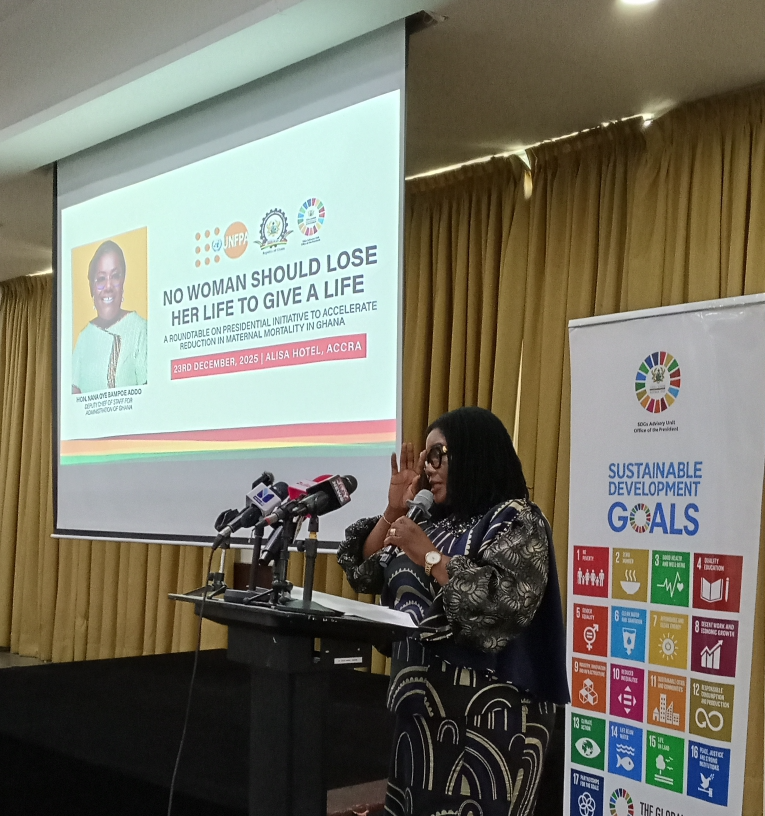
The disclosure was made by the Minister for Gender, Children and Social Protection, Agnes Naa Momo Lartey, at a high-level stakeholder engagement in Accra. She described the situation as deeply troubling, stressing that maternal deaths remain unacceptably high despite years of investment in maternal healthcare.
According to the Minister, Ghana’s maternal mortality ratio has seen only marginal improvement over the past decade, declining from 316 deaths per 100,000 live births in 2010 to 301 in 2020. At the current pace, she warned, Ghana risks missing the Sustainable Development Goal (SDG) target of reducing maternal mortality to 70 deaths per 100,000 live births by 2030.
Data from the Ghana Health Service indicates that progress has stalled, with maternal deaths rising slightly from 100 per 100,000 live births in 2023 to 102 in 2024, fuelling concerns that recent interventions are failing to yield sustained results.
Speaking at the Presidential Maternal Health Dialogue in Accra, Madam Lartey noted that many of the deaths are preventable but persist due to weak health systems, delayed antenatal care, poor emergency transport and referral networks, and socio-cultural barriers that hinder timely care-seeking, particularly in rural and hard-to-reach communities.
The Deputy Chief of Staff at the Office of the President, Oye Bampo, confirmed that nearly 900 maternal deaths had been recorded nationwide as of November 2025, cautioning that the figure could exceed 1,000 by the end of the year if urgent action is not taken.
On behalf of the Health Minister, Dr Hafez Adam Taher, Director of Technical Coordination and Health Planning at the Ministry of Health, acknowledged that Ghana is currently off track on its maternal mortality targets under the Universal Health Coverage roadmap. He attributed the situation to persistent gaps in emergency transport services, blood availability and transfusion systems, weak supply chains for essential maternal health commodities, and inconsistent implementation of maternal and newborn death surveillance mechanisms.
Beyond the health implications, the Gender Minister described maternal mortality as a national development and human rights crisis, disclosing that even the Ministry of Gender has recorded a maternal death among the nearly 900 cases this year.
To reverse the trend, the government says it will intensify interventions, including the uncapping of the National Health Insurance Scheme (NHIS) and the expansion of social protection programmes under the Mahama Cares Initiative, aimed at reducing financial and logistical barriers to emergency maternal care.
Calling for a whole-of-society response, Madam Lartey urged traditional and religious leaders, families, local authorities, civil society, the media and the private sector to take collective responsibility.
“Saving women’s lives is not charity; it is justice,” she said, warning that without urgent and coordinated action, childbirth will continue to claim the lives of Ghanaian women.
DISCLAIMER: The Views, Comments, Opinions, Contributions and Statements made by Readers and Contributors on this platform do not necessarily represent the views or policy of Multimedia Group Limited.
DISCLAIMER: The Views, Comments, Opinions, Contributions and Statements made by Readers and Contributors on this platform do not necessarily represent the views or policy of Multimedia Group Limited.