


BoG Governor Dr. Johnson Pandit Asiama
A leading public-interest advocacy organisation has called on the Bank of Ghana (BoG) to suspend its planned normalisation of non-interest banking, citing significant regulatory, constitutional, and operational defects in the central bank’s proposed framework.
In a formal memorandum submitted on 23 December 2025, Advocates for Christ Ghana, Economy, Finance and Business Sustainability Gate, responded to the Bank of Ghana’s exposure draft of the Guideline for the Regulation and Supervision of Non-Interest Banking.

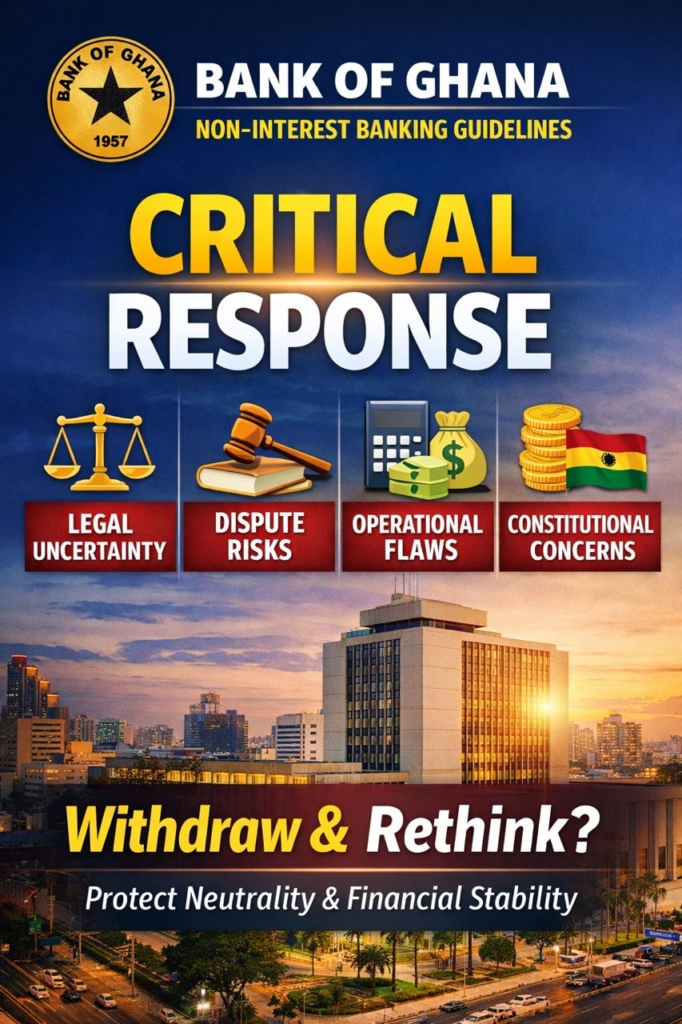
The organisation concluded that the draft guideline, in its current form, is unsuitable for implementation due to what it describes as “material internal contradictions, technical gaps, and prudential risks.”
According to the submission, the Bank of Ghana has not developed a tested, context-specific non-interest banking model suitable for Ghana’s legal and regulatory environment.
Instead, the draft guideline attempts to import external jurisprudential and operational standards into Ghana’s financial system without sufficient adaptation. The group argues that this approach has created contradictions that threaten regulatory coherence, legal certainty, and financial stability.
The memorandum stresses that the push toward normalisation lacks the regulatory clarity, constitutional grounding, and technical justification required for such a major structural change. It warns that the proposed framework risks creating a parallel financial system that does not align with constitutional requirements of neutrality and equal treatment before the law.
The group outlines several defects in the draft guideline, including conflicting standards, unclear supervisory authority, and the establishment of dispute-resolution bodies, specifically the Non-Interest Banking Advisory Committee (NIBAC) and the Non-Interest Finance Advisory Committee (NIFAC), with adjudicatory characteristics.
They argue that these bodies could undermine the central bank’s supervisory primacy and leave consumers of non-interest institutions with weaker protections than those of conventional banks.
Significant concern is also expressed regarding the proposed “window system,” which would allow conventional banks to operate non-interest banking windows.
Advocates for Christ Ghana argues that this model is operationally fragile and opens the door to governance challenges, opaque cost allocations, and regulatory arbitrage, especially in the absence of detailed accounting and audit rules.
The submission further critiques the treatment of accounting, auditing, disclosure, consumer education, staff training, and capital adequacy within the draft guideline. It warns that inconsistent elevation of AAOIFI and IFSB standards could conflict with the authority of the Institute of Chartered Accountants, Ghana (ICAG), creating compliance uncertainty. The group also contends that applying conventional capital adequacy rules to non-interest institutions without dedicated prudential guidance is technically unsound.
The organisation questions the economic justification for establishing a specialised non-interest banking regime, noting that the draft does not demonstrate sufficient market demand or account for systemic and consumer cost implications.
Advocates for Christ Ghana therefore calls for the Bank of Ghana to withdraw and comprehensively revise the draft guideline.
It insists that any future framework must ensure constitutional neutrality, equal consumer protection, supervisory clarity, avoidance of parallel adjudicatory systems, and the establishment of complete prudential and accounting safeguards before any non-interest banking windows are permitted.
The memorandum emphasises that the organisation’s position is grounded in regulatory integrity, constitutional order, and public-interest considerations rather than ideological opposition to non-interest banking.
DISCLAIMER: The Views, Comments, Opinions, Contributions and Statements made by Readers and Contributors on this platform do not necessarily represent the views or policy of Multimedia Group Limited.
DISCLAIMER: The Views, Comments, Opinions, Contributions and Statements made by Readers and Contributors on this platform do not necessarily represent the views or policy of Multimedia Group Limited.