
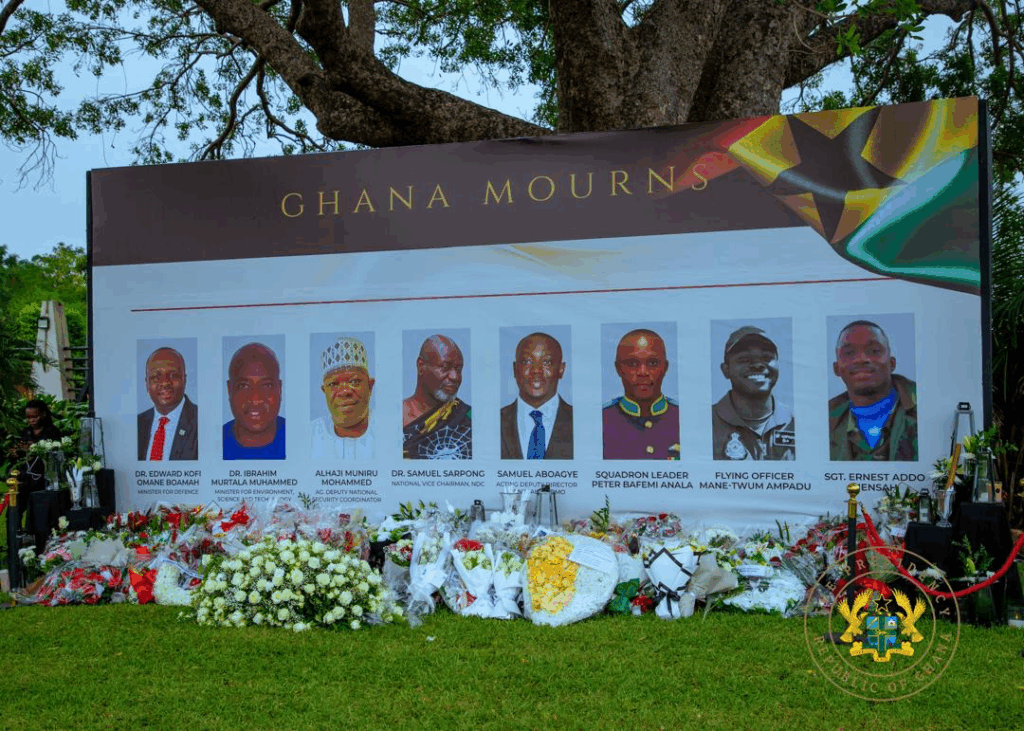
At the heart of Ghana’s resilience stood eight extraordinary souls – the fundamental basis vectors holding our fragile national matrix together. Dr. Edward Omane Boamah was the proportional derivative, delivering swift corrective feedback when the system drifted. Dr. Ibrahim Murtala Muhammed was the integral operator, tirelessly correcting cumulative errors.
Alhaji Muniru Mohammed served as the gradient vector, anticipating shifts and steering us away from instability. Samuel Sarpong was the transformation matrix, converting political discord into unity. Samuel Aboagye provided redundancy paths, preventing collapse. Squadron Leader Peter Anala, Flying Officer Twum Ampadu, and Sergeant Ernest Addo Mensah were the stabilising eigenvectors, enforcing control in the field.
Then came the morning. Ghana awoke to devastating news: these eight gallant men – pillars of strength and service – were lost in a helicopter crash while on their way to confront the relentless battle against the galamsey scourge. Their absence is more than a personal tragedy; it is a structural fracture in our national framework.
This fight has never been only about enforcing laws. It is about dismantling a complex, unstable system riddled with risk, corruption, and deep-rooted decay. With their loss, the matrix becomes singular. The system loses rank. We pivot toward a dangerous critical point of failure.
We owe them more than grief. We owe them the courage to re-engineer the system they died defending – to restore stability not through patchwork fixes, but by recalculating the entire national equation. If we fail, their sacrifice will remain an unsolved problem in Ghana’s history – one we will be condemned to iterate forever, without convergence.
These men were more than constants in the equation of our nation; they were the eigenvectors of resilience within a corrupt matrix, the load-bearing vectors stabilising an otherwise ill-conditioned system. But the galamsey matrix itself is already singular, its rank degraded by decades of graft, complicity, and negligence, pushing Ghana toward systemic failure.
Galamsey is not a simple sum. It is a nonlinear system of feedback loops – greed, poverty, complicity and governance entwined in a complex, high-dimensional space of simultaneous equations. The solution demands multiple vectors of action applied in concert: firm enforcement as the deterministic operator, community education as the probabilistic stabiliser, sustainable livelihoods as the fuzzy controller and an unwavering moral coefficient acting as the scalar multiplier of change.
Yet time slips from the right side of the equation. Every moment’s delay compounds damage like interest on a toxic debt. Rivers silt. Forests vanish. Groundwater poisons. Our nation’s Factor of Safety – both geological and moral – deteriorates exponentially.
The galamsey crisis unfolds like a stochastic process, a Markov chain with hidden states of corruption and neglect. Its rate of change accelerates unpredictably as positive feedback loops amplify instability. Every attempt to suppress galamsey acts like a noisy signal entangled in fuzzy logic – where truth values are uncertain, enforcement is partial, and compliance is probabilistic at best.
Picture the national anti-galamsey campaign as an iterative gradient descent stuck in a rugged, non-convex loss landscape riddled with local minima created by vested interests and corrupted parameters. Each policy step drifts toward an unstable equilibrium, buffeted by stochastic noise from graft and selective enforcement. The ‘black box’ of political patronage obscures transparency, distorts outcomes, and undermines reliable system feedback.
This is a system that fails by design, where stochastic elements like bribery, selective justice and conflicting incentives are baked into the algorithm. Without recalibrating the fundamental parameters – transparency, accountability and genuine political will, every proposed ‘solution’ will remain a temporary patch – a fuzzy logic rules unable to resolve conflicting truths or stabilise the system.
Illegal mining fractures the foundations of our society. Each illicit operation introduces random disturbances – cracks in governance, fissures in public health, and unpredictable environmental shocks. The system’s stability steadily erodes under variable forces beyond control.
The stochastic nature of galamsey, its random, explosive bursts of activity, makes it a dynamic hazard, akin to triggering a landslide through sudden shocks. Corruption and greed act as hidden voids, silently weakening cohesion and magnifying collapse risk.
The fight against galamsey is like trying to stabilise an unstable system with incomplete data and uncertain parameters. Each intervention is only a partial reinforcement, a probabilistic support battling noisy inputs and unpredictable external forces.
The helicopter crash lays bare a deeper failure: the institutional ground beneath us remains unstable. Corruption and political neglect are unresolved stochastic variables, continuously destabilising the system.
It is time to abandon fuzzy policies and half-measures that merely tweak parameters in the wrong direction. The system demands blunt, decisive intervention:
- Zero-tolerance enforcement with measurable consequences – no more selective
application of the law. - Complete transparency with real-time public monitoring dashboards, stripping away
all ‘black box’ patronage. - Independent watchdogs are empowered to audit and sanction without political
interference. - Massive community education and sustainable economic alternatives were deployed, like
a feedback control system stabilising the whole. - A national moral reset – a scalar multiplier of integrity imposed from top down,
bottom-up, and all around.
Anything less, and the galamsey matrix will continue degrading into chaos, its costs measured in ruined lands, poisoned waters, and lost lives.
As we mourn these brave men – the stabilising eigenvectors of our national resilience – we must commit to overhauling the system’s algorithm. Without decisive action, the matrix will remain singular, and Ghana’s future will teeter on the edge of an irreversible landslide. May these fallen heroes be remembered not only as the foundation of hope, but as a call to finally solve the equation – honestly, transparently, and fully.
“Inna lillahi wa inna ilayhi raji’un” – Surah Al-Baqarah (Chapter 2), Verse 156: “Who, when disaster strikes them, say, ‘Indeed we belong to Allah, and indeed to Him we will return.’”
And as Ecclesiastes 12:7 (NIV) reminds us: “And the dust returns to the ground it came from, and the spirit returns to God who gave it.”
*******
The writer, Dr. Musah Abdulai, is a Ghanaian-Australian-based Geotechnical Engineer & Researcher
DISCLAIMER: The Views, Comments, Opinions, Contributions and Statements made by Readers and Contributors on this platform do not necessarily represent the views or policy of Multimedia Group Limited.
DISCLAIMER: The Views, Comments, Opinions, Contributions and Statements made by Readers and Contributors on this platform do not necessarily represent the views or policy of Multimedia Group Limited.