
Ghana’s hard-won progress in reducing air pollution is being quietly reversed, not by traffic or household fuels, but by the growing menace of waste burning.
New scientific findings presented at the Breathe Accra National Stakeholder Convening show that while emissions from vehicles and cooking fuels have stabilised or improved over the past two decades, the open burning of refuse is now driving dangerous spikes in particulate pollution across urban communities.
Researchers, policymakers and clean-air advocates warn that the country risks losing decades of progress if urgent action is not taken to curb the practice.
Accra’s traffic continues to pump pollutants into the air, with more than two million vehicles crowding city streets daily. Yet, contrary to popular perception, transport-related pollution has remained largely unchanged for 20 years.
“What we have found is that the proportion that is coming from traffic remains the same. It hasn’t changed over the last 20 years,” said Dr Raphael Arku.
Dr Raphael Arku, Associate Professor of Environmental Health Sciences at the University of Massachusetts, Amherst and his team have spent two decades collecting and analysing particulate matter in multiple communities, mapping the evolving sources of air pollution.

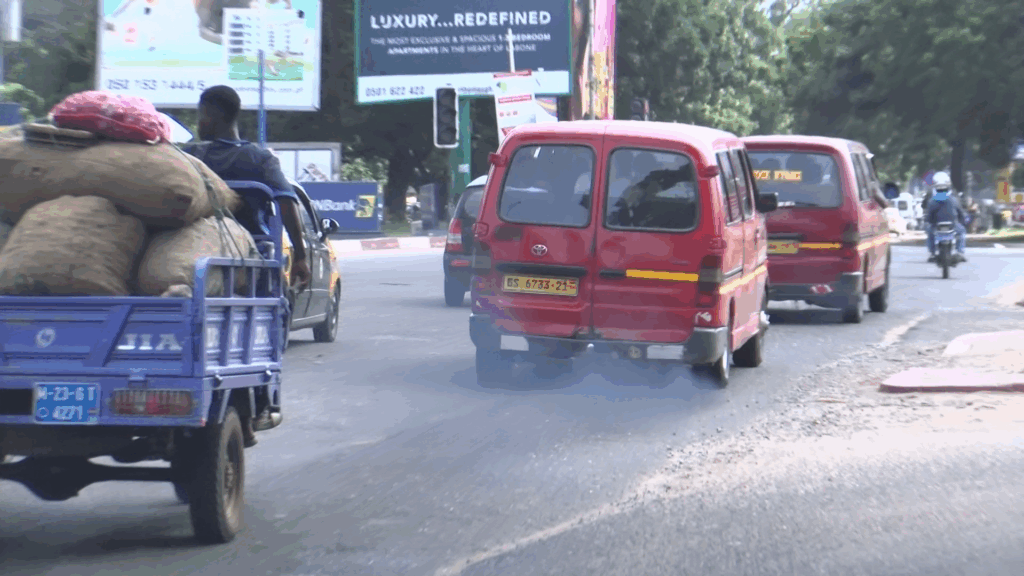
The good news, he explained, is that emissions from biomass burning — charcoal, wood fires and fish smoking — have dropped significantly as more households shift to improved fuels.
“But the good news is that we have also found that the one that is coming from biomass burning, like when we burn wood for cooking or fish smoking or charcoal, that part has reduced significantly, a lot,” Dr Raphael Arku said.
Policies like the ban on old vehicle imports and the new emissions levy were expected to further cut pollution from transport. But the emissions levy fell short of its goals.
A trend analysis by Dr Dan Westervelt of Columbia University found no statistically meaningful improvement.
“We did not see any PM2.5 change between the post-levy period and the pre-levy period. Basically, there were some changes, but statistically insignificant changes, very, very tiny, like a fraction of a per cent change in air pollution due to the policy.
“So we can say pretty definitively that at least for PM2.5, which is the primary pollutant of health concern for air quality, at least for PM2.5, there was not a substantial reduction due to this emissions policy,” said Dan Westervelt.

PM2.5, fine particles that penetrate deep into the lungs, remains the most dangerous air pollutant.
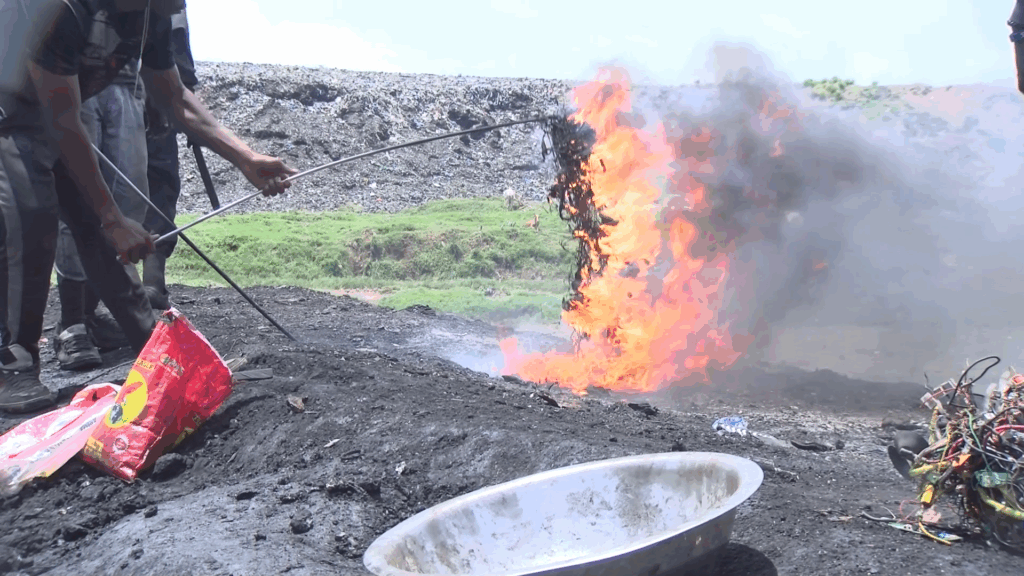
But the biggest red flag from the new research is this: waste burning is on the rise, and it is cancelling out pollution gains from cleaner fuels.
With weak waste-collection systems, many communities resort to burning rubbish, releasing toxic smoke directly into the air people breathe.
“But unfortunately, that reduction, we are making up for it, making it more negative by burning waste. So even though we are making progress in people switching to gas, which is less polluting, we are also not doing well in trash collection.
“So people are now burning the trash. So it’s making up for the gains that we make in biomass burning,” Dr Raphael Arku said
Experts also highlighted the lack of safe pedestrian and cycling infrastructure as part of the broader problem.
Director for Planning and Programmes at the National Road Safety Authority, Martin Afram, said mainstreaming non-motorised transport is crucial.
“We lose about 2,400 people to traffic crashes. And out of this number, 31.3% of them are as a result of the pedestrians. So this tells us that if you’re able to reduce the numbers with regard to the pedestrian fatalities, we’ll be reducing overall road traffic fatalities.
“The key thing is that we want to mainstream the provision of bicycle lanes and pedestrian walkways into the road infrastructure. And this is well spelt out in the National Transport Policy,” said Martin Afram
Breathe Accra, which funds air-quality research, including Dr Arku’s work, says the next phase is ensuring policies can actually be implemented.
“We are hoping we can see some more mainstreaming and then build more on our awareness and also the capacity to implement these policies. Because it’s good to know that we’ve done an air quality action plan, but do the people know how to implement it?
“So we’re hoping to build on the work we’ve done, the foundation we’ve laid, and see how things can scale off to even be able to create more impact and get more results at the end of the day,” said Dr Elvis Gyeabuor
With air pollution now linked to nearly 32,000 deaths, he argues that the stakes are too high for weak enforcement.
Technical Head for Breathe Cities Africa, Seneca Naidoo, praised Accra’s multi-district coordination but urged consistency.
“We want to make sure that we’re able to strike a good balance between protecting people’s health, but still making sure that economies are growing. This is not a problem that respects boundaries, you know, it doesn’t stop at the, you know, the border of the Accra Metropolitan Assembly and say, okay, I can’t go past this, right?
Now you’ve got those in 13 different districts, that’s a lot of people to come together to make sure that you move this work forward. And the fact that the city has been able to do that, I think, is really, really a great achievement. So I think that’s something that we want to see a lot more,” said Seneca Naidoo.
The message from researchers is clear: Ghana has made real progress — cleaner fuels, stable transport emissions, coordinated policy efforts. But without urgent action on waste management and community behaviour, that progress will vanish.
Cleaner air is still within reach. But it demands enforcement, investment in waste systems, and the collective will to stop burning trash.
DISCLAIMER: The Views, Comments, Opinions, Contributions and Statements made by Readers and Contributors on this platform do not necessarily represent the views or policy of Multimedia Group Limited.
DISCLAIMER: The Views, Comments, Opinions, Contributions and Statements made by Readers and Contributors on this platform do not necessarily represent the views or policy of Multimedia Group Limited.