

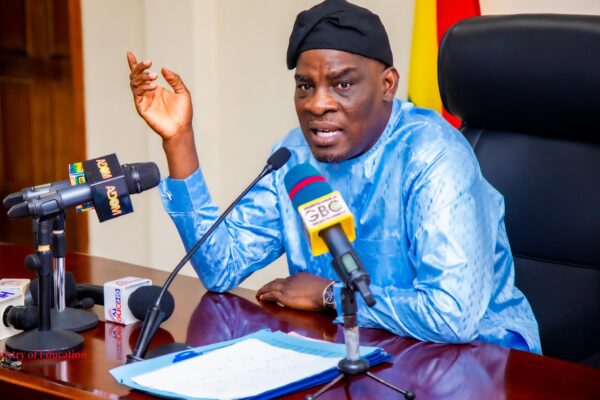
The Minister for Education, Haruna Iddrisu, has highlighted Ghana’s growing investment in educational technology, including the deployment of artificial intelligence tools in senior high schools.
Addressing participants at the 4th Africa Education Summit on March 18, he said Ghana is pursuing an ambitious digital transformation agenda aimed at improving access, quality, and equity in education.
“As Minister for Education, I remain firmly convinced that education must function as the great localiser within our societies. Educational technology, therefore, must not become the privilege of a few institutions or urban communities,” he stated.
“It must serve as a powerful instrument for expanding opportunity for every child, irrespective of geographical location or socio-economic circumstances,” he added.
Mr. Iddrisu revealed that Ghana has made notable progress through coordinated digital initiatives led by the Ministry of Education and its key agencies.
“A central component of this transformation is the deployment of subject-specific artificial intelligence applications across senior high schools in the country,” he noted.
According to him, these AI tools are designed using Ghana’s national curriculum to support teaching and learning.
“These applications are designed using Ghana’s national curriculum materials to support teachers in lesson preparation, assessment development, and classroom delivery, while strengthening learner engagement and ensuring alignment with national standards and values,” he explained.
He further cited the introduction of a national digital assessment platform.
“Complementing this effort is the operationalisation of a digital assessment and data management platform that enables schools to keep continuous assessment records electronically,” he said.
Despite the progress, the minister acknowledged persistent challenges across the continent, including infrastructure deficits and limited access to digital tools.
“Many communities across our continent continue to experience limitations in digital infrastructure, connectivity, teacher training, and access to locally relevant digital learning resources,” he admitted.
He therefore called for stronger partnerships to address these gaps.
“The government of Ghana firmly believes that effective partnerships among governments, academic institutions, development partners, and the private sector will remain essential in building resilient and technology-enabled education systems across the continent,” he stressed.
Mr Iddrisu concluded with a call for action-oriented outcomes from the summit.
“Let us remember that the future of education in Africa depends on our collective ability to translate dialogue into implementable strategies… We must leave this summit with a clear and unified roadmap that ties governments and institutions across Africa in integrating educational technology responsibly, inclusively, and sustainably,” he said.
DISCLAIMER: The Views, Comments, Opinions, Contributions and Statements made by Readers and Contributors on this platform do not necessarily represent the views or policy of Multimedia Group Limited.
DISCLAIMER: The Views, Comments, Opinions, Contributions and Statements made by Readers and Contributors on this platform do not necessarily represent the views or policy of Multimedia Group Limited.