



Hugh SchofieldParis correspondent

 AFP
AFP
Is the far left about to replace the far right as the pariah of French politics?
The question is inescapable following the killing in Lyon of nationalist student Quentin Deranque by suspected far-left militants.
Deranque was killed on 12 February after a small university protest by far-right feminists, who he was supposed to be protecting.
Mobile phone footage shows him being repeatedly kicked and punched on the ground by masked and hooded young men. He died of head injuries.
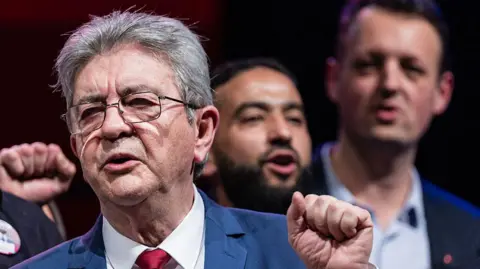
Since then a torrent of condemnation has come down on the main party on the radical left, La France Insoumise, and on its leader, veteran firebrand Jean-Luc Mélenchon. LFI – or France Unbowed – has a bloc of some 70 MPs in the 577-member National Assembly.
The seven suspects now charged in connection with the killing were all members of, or close to, an organisation called La Jeune Garde (The Young Guard) which used to provide security for LFI before it was banned last year.
One of the suspects – Jacques-Elie Favrot – was the salaried parliamentary assistant of an LFI deputy, Raphaël Arnault, who set up The Young Guard in 2018.
Favrot has been charged with “complicity to murder by instigation”, not with delivering the blows that killed Deranque.
But Adrian Besseyre – who according to his lawyer also worked in Arnault’s team at the National Assembly – is one of those charged with murder.
All the suspects deny any intention to kill, according to the investigating magistrate. Two refused to talk, he said, while the others admitted being at the scene, and some admitted inflicting blows.
 AFP
AFP
For the past 50 years it was a constant accepted by most of the French political establishment that the party to be ostracised for its links to extremism lay at the other end of the political spectrum: the National Front, and its successor the National Rally (RN).
What has happened in the last 10 days could be turning that nostrum on its head – completing the “de-demonisation” of the RN so fervently pursued by its leader Marine Le Pen, and making new “demons” out of the radical left.
The implications on future elections in France – and on who eventually comes to power – could be profound.
From diametrically opposing points of view, the RN and LFI both reject the consensus that has governed France for the last 50 years.
With its nationalist traditions, the RN promotes the interests of French citizens over immigrants, and takes a tough line on crime which it links with some immigrant communities. True to its Marxist roots, LFI defends a working class which it sees as now being mainly of immigrant origin.
On economic matters the two parties are not a million miles apart. But on touchstone “identity” issues, there is mutual hatred.
On Gaza, LFI refused to condemn the deadly Hamas-led 7 October attacks on Israel, while RN – for all its antisemitic past – sides increasingly with Israel.
 AFP via Getty Images
If the untouchable stain shifts from one to the other – from far right to far left – the implications for the future of France could be profound.
Until now the far right has been kept at bay by a cordon sanitaire applied by the rest of the parties.
The RN may be the most popular party in the country, but it finds it hard to win elections because opponents make arrangements among themselves to ensure the anti-RN vote is united.
A classic example was at the last legislative elections in 2024, called following President Emmanuel Macron’s sudden dissolution of the Assembly.
The RN was expected to sweep the board and did well in the first round of voting.
But in the decisive second round, Macronite and left-wing candidates stood aside in order to concentrate the anti-RN vote. The result was a resurgence of the left and centre, with the RN winning only 120 or so seats – and no majority for anyone.
But this machination was only possible because other parties were willing to deal with Mélenchon’s LFI – a party which, unlike the RN, was considered part of the “Republican arc”, in other words acceptable.
 Reuters
But what if that is about to change because of the murder of Quentin Deranque and the implication of young men with links to LFI?
What if the Socialists with their 70 or so MPs, and the centrists with about 160, refuse now to cut any kind of deal with LFI? Suddenly the blocking majority against the far right begins to collapse.
But there’s more. What if the mark of shame shifts so completely to the far left that the far right becomes clean by comparison?
Then the conservative Republicans – with about 50 seats in parliament – start openly dealing with the RN. And the far right is at the portal of the mainstream.
All this could already have important repercussions in the municipal elections which take place next month across France.
How much more significant it will be when voters come to choose who rules the country – at the presidential and parliamentary elections of 2027.
Writing in the conservative Le Figaro newspaper, commentator Guillaume Tabard put it succinctly: “Since Quentin Deranque’s death, the political landscape has shifted.
“Mélenchon’s party has become the formation that is the most condemned in politics and the media. For [the RN] it is a godsend, after half a century in which the distinction belonged to it.”
Circumstances have certainly played hugely into the far right’s hands.
Le Pen and party president Jordan Bardella are accustomed to accusations targeting the RN’s own links with disreputable “security” organisations or electoral candidates with unacceptable pasts.
Now they need barely to open their mouths. The rest of the political class is doing their work for them, as centrists, conservatives and moderate left-wingers alike join the anti-LFI campaign.
The process of ostracism is all the more ineluctable because LFI itself has clearly decided that the worst policy would be to show remorse.
Naturally they condemn the killing, but Mélenchon refuses to condemn The Young Guard or to suspend its founder Raphaël Arnault as an MP.
For France’s mainstream left, it is all deeply disconcerting. They are caught between the need to distance themselves from LFI and the ingrained instinct not to give succour to the far right.
It is a hopeless situation, and their only recourse is to keep reminding voters that the RN has its own history of ambivalence towards violent extremism.
“By focusing all our attacks on the LFI, we are creating a corridor of respectability for the RN,” lamented the former prime minister and possible 2027 presidential candidate Dominique de Villepin, a conservative in the past but now shifting to the left.
“We are offering the RN what it has always dreamed of: the appearance of normality.”